Brain or Body? You Don't Have to Pick a Camp!
You've been told your tests are normal, so nothing must be wrong. You've noticed stress makes your symptoms worse, and someone took that as proof it's psychological. You've been handed a brain-based approach that felt like being told it's all in your head. Or you've been told the opposite: that anything involving the nervous system is a dismissal of your very real illness.
You're the one piecing together your own care, because the system isn't doing it for you. And maybe you've done the nervous system work, consistently, and you're still sick. So now there's a quieter question underneath everything: What am I doing wrong?
The through-line is both/and: central nervous system mechanisms are real, and so is the biology; the blood volume problem in POTS, the inflammation and cerebral blood flow findings in ME, that no amount of regulation work resolves. When patients are taught only half of the information, continued illness starts to feel like personal failure.
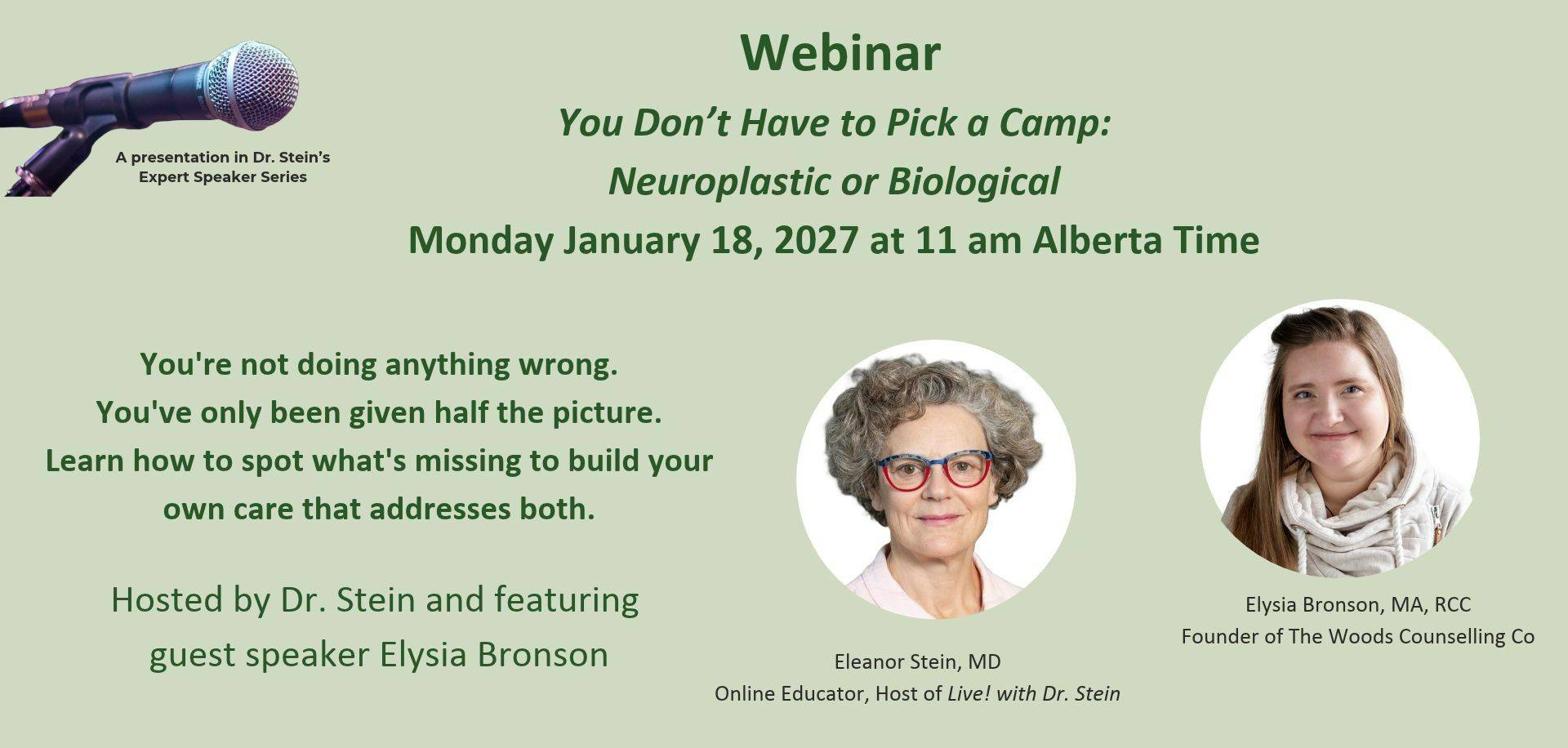
You're not doing anything wrong.
You've only been given half the picture.
When patients are taught only that central nervous system mechanisms are real, continued illness starts to feel like personal failure. But central nervous system mechanisms are real, and so is the biology.
This presentation covers three linked things:
- The distinction between neuroplastic and biological symptoms. What each term actually means, why "biological" doesn't always mean measurable, why "neuroplastic" never means imagined, and why a condition being worsened by stress is not the same claim as a condition being psychological.
- How to assemble your own resources and care team to replace a system that doesn't do it for you.
- The nervous system tools that help with symptom management, taught as physiology rather than as a promise.
This presentation will teach you
- What "neuroplastic" and "biological" actually mean, and what the evidence does and doesn't support for each, including the less flattering parts of the mind-body evidence base
- Why a symptom that responds to stress is not thereby a psychological symptom, and the glial and neuroinflammation mechanism that explains why.
- The measurable harm of premature psychologising, including that it trains patients to under-report symptoms to their own doctors.
- How to build a care team by function rather than by specialty, and how to spot which function is missing.
- The nervous system tools framed honestly: what they do, what they don't, and how to set goals in terms of symptom load, function, and relapse prevention rather than recovery
The webinar will last approximately 90 minutes:
- 5-10 minute introduction
- 40-minute presentation
- 10-minute break
- up to 30 mins of Q&A
Join us on Monday, January 18, 2027
at 9:00 am Pacific / 11:00 am Alberta / 1:00 pm Eastern
(Alberta Time is UTC-6)
Time converter at worldtimebuddy.com
 This presentation is part of Dr. Stein's Expert Speakers Series. These will be held approximately monthly, and each session will feature a different guest expert on topics of interest to people with complex chronic disease, chronic disease in general, and people interested in living healthier, longer.
All webinars are recorded. When you register, you get indefinite access.
ALL presentations in the Expert Speakers Series are free with a membership to Live! with Dr. Stein.
Purchase Options
Low Income
About the Presenters
Elysia Bronson, MA, RCC
Elysia Bronson is a Registered Clinical Counsellor (RCC) and the founder of The Woods Counselling Co., working online with adults across Canada living with ME, fibromyalgia, long COVID, POTS and dysautonomia, MCAS, hypermobility, and chronic pain. And with the medical trauma that usually comes with them.
She is the Interprofessional Co-Chair of the Canadian Pain Society and a volunteer with Pain BC, and the developer of Universal Pain Therapy, a framework integrating the Safe and Sound Protocol, Pain Reprocessing Therapy, DBT skills, and pacing. She lives with several of these conditions herself.

Eleanor Stein, MD
Dr. Eleanor Stein brings a rare combination of over 35 years of lived experience and medical expertise in myalgic encephalomyelitis, chronic fatigue syndrome, fibromyalgia, environmental sensitivities, long COVID and chronic pain.
She became ill with ME, CFS, FM and MCS in 1989. Since then, she has experienced, studied, and treated the full alphabet of related conditions, including joint hypermobility, orthostatic dysfunction and mast cell activation syndrome. She has personally tried hundreds of approaches, attended hundreds of medical conferences, and reviewed thousands of peer-reviewed papers to determine what works best for the greatest number of people.
Since retiring from medical practice at the end of 2022, Dr. Stein has dedicated her time to integrating emerging research in neuroplasticity, hormesis, circadian biology, and related fields. While traveling in her camper van, she continues to study and translate this research into practical, accessible programs designed to make the healing journey easier, safer, and more effective.